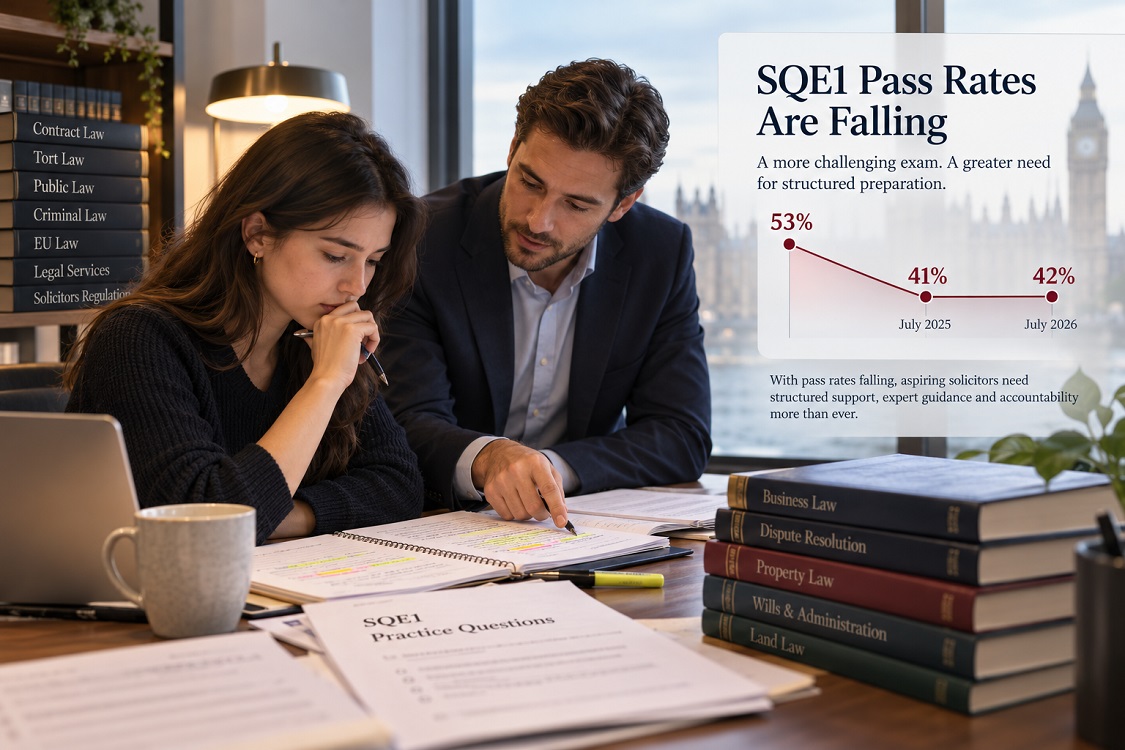
The latest SQE1 results make sobering reading for aspiring solicitors. Figures from the Solicitors Regulation Authority show that only 42% of candidates who sat both papers in July 2026 passed. That is a sharp fall from January’s 53%, and only a single point above the record low of 41% set in July 2025.
For anyone planning to sit the exam, the message is clear: more than half of candidates are leaving the assessment centre without the result they need.
What the pass rate numbers tell us
In total, 6,315 candidates completed both Functioning Legal Knowledge papers in the July sitting. Of these, 5,012 were taking the exam for the first time and 1,303 were resitting one or both papers. First-time candidates did slightly better, with 47% passing, a marginal improvement on the 46% recorded a year earlier.
FLK1 and FLK2 each produced a 50% pass rate across all candidates. That may sound reasonable on paper, but because candidates must pass both papers to clear SQE1, the overall success rate drops considerably.
The SRA points to a familiar pattern. Over the past three years, January results have consistently come in 10 to 15 percentage points higher than July’s. The regulator attributes this partly to differences in how candidates have trained and partly to the number of resitters, who historically perform less well. The July cohort included the largest share of resitters on record: almost a quarter of FLK1 candidates and over a quarter of FLK2 candidates were taking the paper again.
The SRA also emphasises that there is no fixed pass mark. Each paper’s threshold is set individually to reflect its difficulty, while the standard required stays constant. In other words, the exam is not getting easier to make up for low pass rates.
Why so many SQE candidates struggle
SQE1 is a test of breadth as much as depth. Candidates must apply legal principles across a wide range of subjects under strict time pressure, using single best answer questions designed to separate partial knowledge from genuine understanding. Many students have also reported that the exam feels rushed, a concern serious enough that the SRA has recently reduced the number of questions.
Self-study alone often isn’t enough. Candidates can spend months reading textbooks and still underperform because they haven’t learned how to apply the law quickly and accurately in the exam format. Resitters face an added challenge: repeating the same approach rarely produces a different result.
The case for SQE tutoring
This is where targeted SQE tutoring can make a real difference. A good tutor identifies weak areas early, rather than leaving them to surface on exam day. They teach candidates how to break down long scenario questions, spot the decisive legal issue and eliminate wrong answers efficiently, which are skills that textbooks rarely develop.
Tutoring also brings structure and accountability. With a clear revision plan and regular progress checks, candidates are far less likely to drift through months of unfocused preparation. For resitters especially, an experienced tutor can diagnose exactly what went wrong and rebuild their approach from the ground up.
Final thoughts
With pass rates hovering in the low 40s, SQE1 demands more than hard work. It demands the right preparation. Candidates who invest in expert support give themselves a far better chance of joining the minority who pass first time.